
Love in an Edmund Blair Leighton painting is rarely just a matter of two people standing together.
There is usually a moment to consider. A meeting. A promise. A departure. A decision that has already been made or one that is about to be made.
That sense of suspended action is central to Leighton's appeal. His paintings often place figures inside carefully reconstructed historical settings, yet the emotions are easy to recognise. The costumes may belong to another age. The hesitation does not.
Leighton built his career around historical genre painting and exhibited regularly at the Royal Academy from 1878 onward. His subjects ranged across seventeenth- and eighteenth-century scenes, literary and legendary subjects and episodes drawn from national history. Romantic relationships formed an important part of that wider body of work.
His historical settings gave him a useful distance from contemporary life. A couple could be separated by duty, social expectation, family authority or war and the situation could still speak to a Victorian audience.
That is one reason his paintings of love don't all look alike.
Courtship and attention
Courtship is often about looking before it becomes about touching.
In Courtship, even the title asks us to think about a relationship in progress rather than one that has reached its destination. The subject is not marriage itself. It is the uncertain space before it.
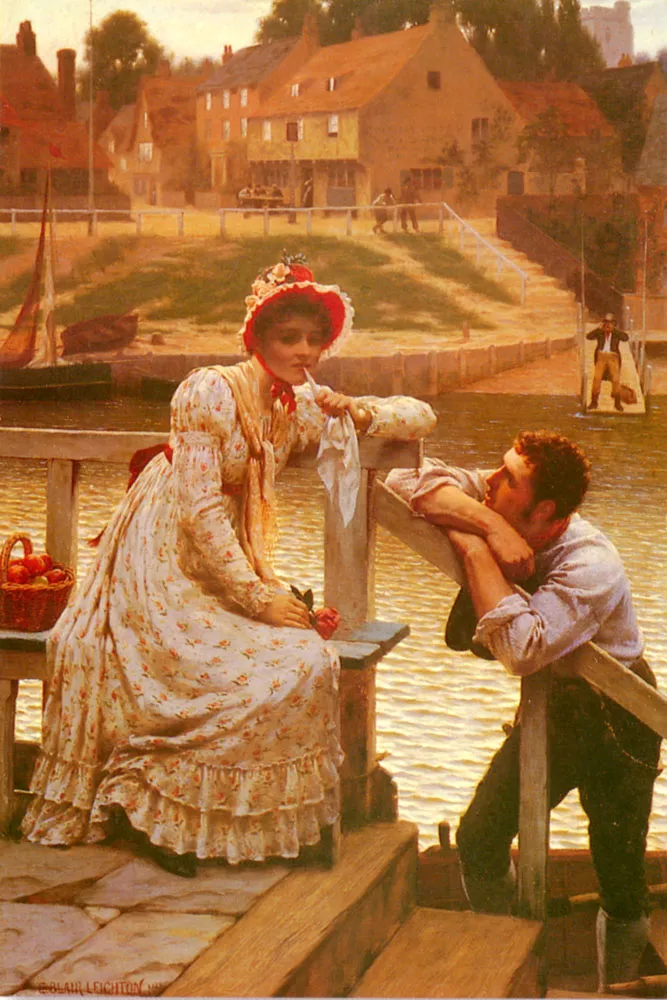
That distinction matters in Leighton's work. A completed relationship can be represented through ceremony or commitment. Courtship allows him to work with possibility.
The figures in these scenes are often surrounded by objects and settings that slow the eye. Clothing, furniture, architectural details, flowers, books, instruments and carefully arranged interiors can all contribute to the sense that the moment has been deliberately composed. Leighton's historical reconstruction was not incidental decoration. He collected furniture, arms, metalwork and other objects that could assist his elaborate historical scenes.
There is something theatrical about this method, but the emotion doesn't have to be theatrical.
A glance can be enough.
The same tension between private feeling and social circumstance appears throughout Leighton's romantic subjects. His historical characters may live in an imagined past, but they are often placed in situations that contemporary viewers could immediately understand.
The ceremony
Marriage changes the atmosphere.
A courtship scene can leave the future open. A wedding makes a public statement. The private relationship has entered a social world, with witnesses, ritual, clothing, architecture and convention suddenly becoming important.
Signing the Register is especially useful for thinking about this change. The title focuses attention on an ordinary administrative act, yet within the context of marriage it becomes something more significant. A signature fixes a moment that otherwise passes quickly.
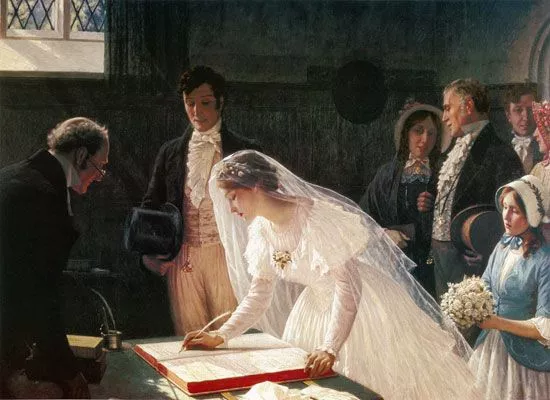
Leighton was interested in precisely these kinds of moments. His historical paintings often depend on an event being caught just before or just after something decisive happens.
His 1888 painting To Arms! provides a striking example. The work shows a newly married couple leaving a church when an armed knight arrives with news that the groom must join the fighting. Christie’s describes it as one of a series of paintings in which Leighton placed a knight and his lady within incidents associated with chivalry.
Marriage, in this case, doesn't end the story.
It complicates it.
The wedding becomes the beginning of another kind of narrative, one in which devotion has to exist alongside duty.
When love means farewell
Leighton's romantic world becomes more interesting when the couple cannot simply remain together.
Adieu shifts the emotional emphasis from union to separation. Even the title is brief. Goodbye.
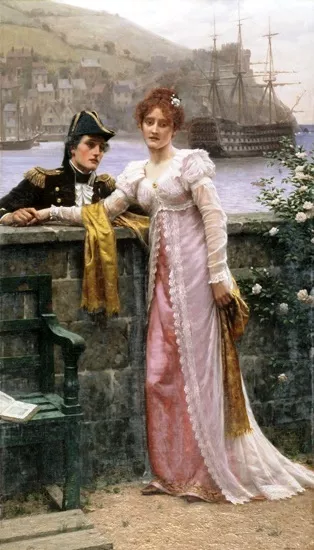
Farewell scenes give Leighton a different visual problem from courtship or marriage. There is no need to explain the relationship. What matters is the interval before one figure disappears from the other's life.
His chivalric paintings make frequent use of this structure. In God Speed, exhibited at the Royal Academy in 1900, a young woman prepares her knight for departure while he is already mounted and armed for a tournament. The painting turns an act of devotion into a moment of imminent separation.
That is characteristic of Leighton.
He doesn't need a dramatic battle in progress. The emotional charge can come from the knowledge that something is about to happen.
A farewell can be quiet.
Sometimes that makes it more affecting.
Devotion under pressure
Till Death Us Do Part takes the idea of commitment further. The title itself makes an absolute promise. Unlike courtship, there is no uncertainty in those words. Unlike a farewell, there is no suggestion that separation has cancelled the bond.
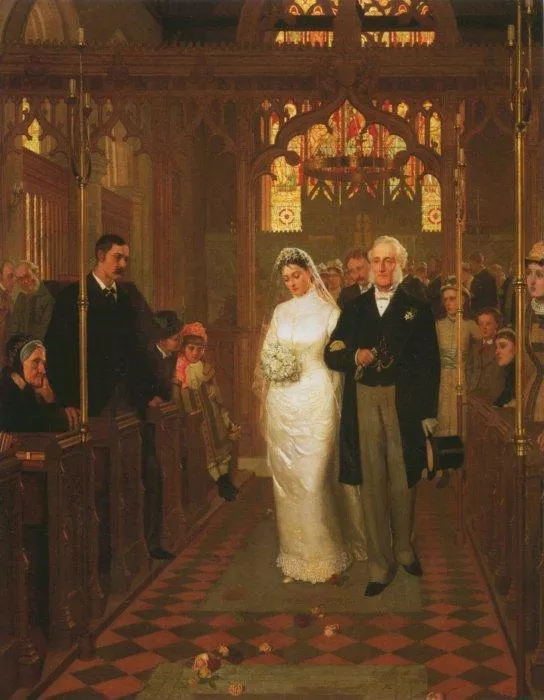
The phrase also introduces time.
Love is no longer represented simply as attraction between two people in a particular room. It becomes something measured against what may come later.
This concern with devotion, duty and separation runs through Leighton's historical subjects. God Speed, The Accolade and The Dedication form part of a group of works in which knights and their ladies appear in scenes associated with chivalric ideals. Christie’s places these paintings within the late Victorian revival of interest in medieval and national legend.
Leighton could therefore use the past almost as a stage for contemporary feelings.
The armour is historical.
The dilemma is not.
That may explain why his romantic paintings can feel more personal than their elaborate settings initially suggest.
Love as legend
Tristan and Isolde brings another dimension to Leighton's treatment of love. Here the subject belongs to literary and legendary tradition rather than the everyday world of a wedding or courtship.
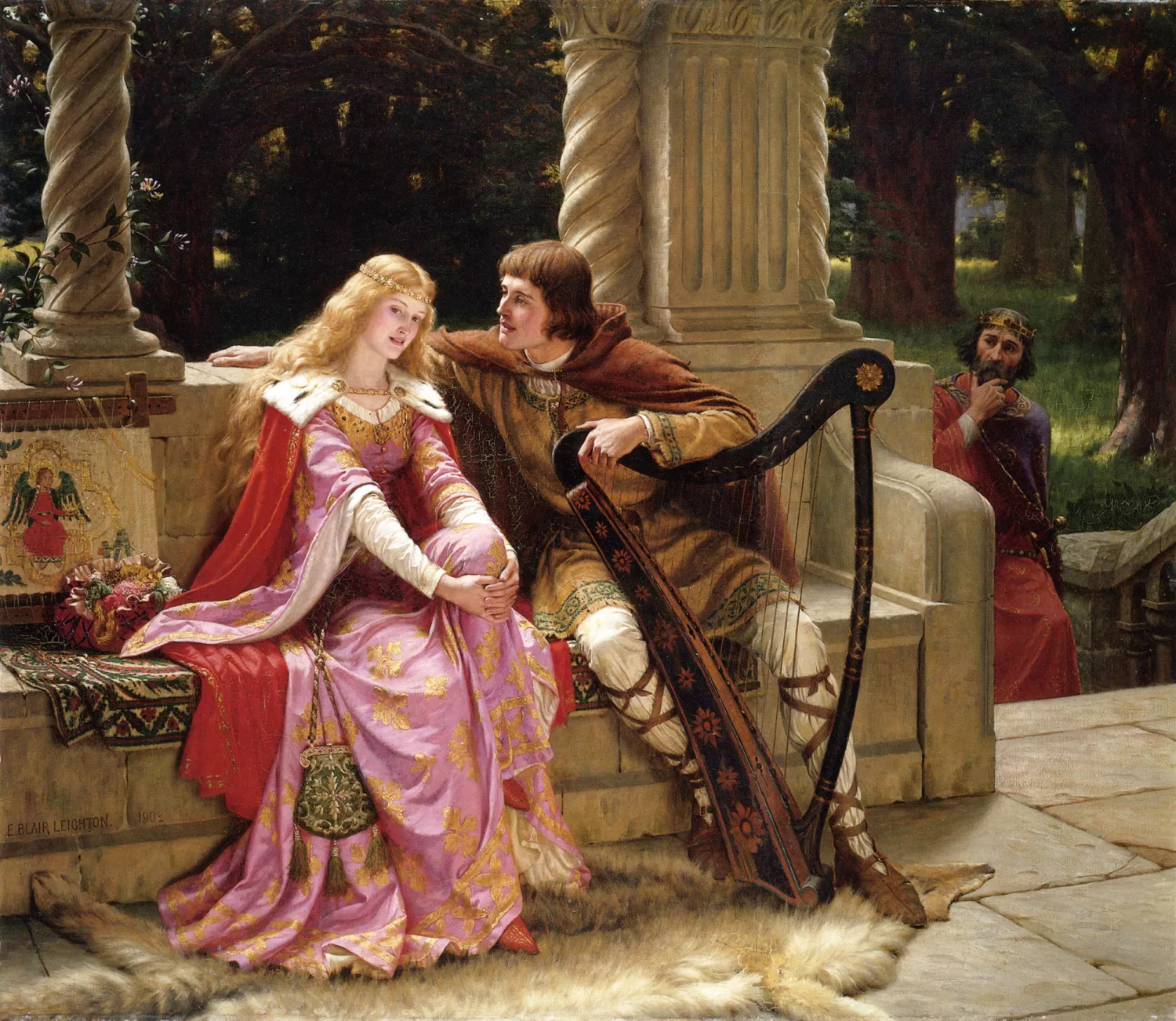
The advantage of legend is that the emotional stakes are already large. Tristan and Isolde are not simply two people meeting for the first time. Their story has been retold for centuries, carrying ideas of desire, loyalty, conflict and tragic consequence.
Leighton was drawn repeatedly to this kind of historical and literary material. His oeuvre included subjects derived from Arthurian legend and literary sources alongside domestic and historical scenes.
Yet he generally gives these stories a tangible physical world.
Fabric has weight. Stone has texture. Metal catches the light. A figure's posture tells us where attention is directed.
The result is a curious balance. The subject may be legendary, but the painting remains grounded in visible things.
A different kind of romance
Across these paintings, Leighton doesn't offer one definition of romantic love.
Courtship is anticipation.
Marriage is ceremony.
Farewell is separation.
Devotion is endurance.
Legend turns private feeling into something larger and more dangerous.
This variety is important when looking at paintings by Leighton as a whole. It would be easy to reduce his romantic subjects to attractive costumes and picturesque historical interiors. The paintings are more carefully constructed than that. Their drama often depends on what has just happened, what is happening now and what the viewer knows is about to happen.
That is also why the relationships in these scenes remain legible even when the historical setting is unfamiliar. Leighton places emotion inside a world of ritual and circumstance, then lets the viewer find the human situation underneath it.
A wedding can become a departure.
A courtship can become a promise.
A promise can be tested by duty.
And a goodbye can contain an entire love story.
Perhaps that is the quiet strength of Leighton's paintings. He doesn't need to bring romance into the present day to make it recognisable. He moves it into another century, gives it armour, silk, old stone and ceremonial spaces, then leaves us with the part that hasn't changed: two people looking at each other when something important is about to begin or end.